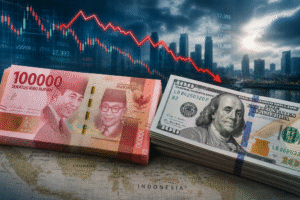
Source: mistar.id
Jakarta – On Tuesday, 5 May 2026, the exchange rate of the rupiah against the U.S. dollar has once again come under significant pressure, breaking through a new psychological level. Based on Bank Indonesia’s (BI) reference rate data, the selling rate for the U.S. dollar stood at Rp17,454.84, while the buying rate was recorded at Rp17,281.16 per U.S. dollar. Bloomberg data at 10:32 a.m. WIB on the same day confirmed this trend, with the rupiah in the spot market trading at Rp17,428 per U.S. dollar.
This phenomenon is not an isolated event but rather the result of accumulated external pressures and internal seasonal factors. Globally, escalating geopolitical tensions in the Middle East have become a primary catalyst for increased global uncertainty. These conditions have prompted market participants to shift toward safe-haven assets, with the U.S. dollar remaining the preferred instrument, thereby increasing demand for the greenback and placing pressure on emerging-market currencies, including the rupiah.
Meanwhile, on the domestic front, Coordinating Minister for Economic Affairs Airlangga Hartarto identified at least two seasonal factors contributing to pressure on the rupiah. First, the Hajj season, involving around 221,000 pilgrims, has increased demand for U.S. dollars to cover travel expenses and operational needs. Second, as the second quarter begins, dividend payments to foreign investors have risen, which are generally denominated in U.S. dollars.
In response to these conditions, monetary and fiscal authorities have prepared stabilization measures. Bank Indonesia has consistently implemented dual interventions, operating in the foreign exchange market to stem the pace of depreciation while simultaneously purchasing government securities in the secondary market. Furthermore, structural measure are being persued through the realignment of bilateral financial transactions aimed at reducing reliance on the U.S. dollar. Concrete steps include strengthening the Local Currency Settlement (LCS) mechanism with key trading partners such as China, Japan, and South Korea, as well as gradually shifting the composition of foreign loans from the U.S. dollar to regional currencies such as the yuan or yen to ease pressure on the national balance of payments.
The rupiah’s depreciation towards Rp17,454 level serves as an important signal that external and domestic pressures are converging. The effectiveness of Bank Indonesia’s interventions, along with the transition toward alternative currencies will be key factors in determining the rupiah’s short-term trajectory. Students and economic observers are advised to closely monitor these developments, particularly regarding their potential impact on imported inflation and the rising cost of studying abroad.(AJ/NFA)
You may also like
Menekuni Peristiwa G30S/PKI dan Memastikannya Tidak Terulang Lagi
Di Balik Fenomena Lapas Mewah: Ada Pengawasan yang Perlu Dipertanyakan
Kembalinya Tren Gyaru di Masa Kini
Dari Klub Malam ke Jogging Track: Cara Baru Gen Z dalam Melepas Penat
Tatap Langit, Bukan Layar: Berdiam Sejenak Tanpa Ponsel demi Menyelamatkan Kewarasan